• Skip to main content
  • Skip to footer

Social Media Helpline

Lessons from Piloting a Social Media Helpline

  • About
  • Key Takeaways
  • For the Future
  • Contact
  • SOCIALMEDIAHELPLINE.COM

Blog

iCanHelpline to support Seattle Public Schools 2017-’18

October 8, 2017 By ICanHelpline

FOR IMMEDIATE RELEASE – OCT. 5, 2017

Media Contacts:
Seattle Public Schools: Kim Schmanke, 206-252-0203 (desk), kaschmanke@seattleschools.org
iCanHelpline.org: Anne Collier, 650-458-7948, annecollier@gmail.com
Google: Sam Leeds, 415-342-9923, sleeds@cplusc.com

TO MARK NATIONAL BULLYING PREVENTION MONTH, SEATTLE PUBLIC SCHOOLS AND ICANHELPLINE PARTNER TO REDUCE CYBERBULLYING

Through a Google grant, iCanHelpline.org, the new social media helpline for schools, will provide Seattle Schools with help in addressing online harassment

SEATTLE—[October 5, 2017]——As part of National Bullying Prevention Month, Seattle Public Schools (SPS) and iCanHelpline.org today announced the launch of a year-long pilot program and partnership to provide schools another tool to address online harassment, intimidation and bullying of students.
This pilot is made possible through a Google grant, which will give 40+ SPS middle and high schools access to email or call the helpline toll-free for assistance with social media in schools, specifically navigating apps and services, reporting abuse, and addressing harassment, cyberbullying, and other harmful content.

School and district personnel will receive:

  • Toll-free and email access to help when social media incidents happen
  • Research-based social media advice for smart, restorative incident response
  • Help with navigating apps, reporting abuse and working with students to resolve cyberbullying problems on social media
  • Assistance through the helpline’s contacts at Instagram, Snapchat, Twitter, Kik, Tumblr and other apps that are popular with students.

“We want our schools to be safe places that foster positive change and growth for all of our young people,” said Tina Meade, SPS student civil rights compliance officer. “It is part of all of our responsibility, as educators, parents and community members, to help students learn how to interact with each other with respect and civility, and how to build resiliency in the face of adversity.”

The pilot program is part of an integrated district approach to keeping students safe from harassment, intimidation and bullying.

“With 92 percent of US teens online daily, 24 percent ‘almost constantly,’ and about a third having experienced cyberbullying, schools need and deserve help when problems turn up in social media,” said iCanHelpline founder Anne Collier. “The helpline is social media intelligence and take-down help for school incident response.”
Google has supported the development of iCanHelpline as a resource for schools, including financial support of the nonprofit’s initial pilot, and its statewide deployment throughout California last year.

“We all use the web to learn, play, and communicate, and students are no exception,” said Darcy Nothnagle, head of external affairs for the NW at Google. “We’re proud to support iCanHelpline as a resource for Seattle schools to help keep kids safe online.”
Access to iCanHelpline.org is limited to school or district staff. Links to emergency and specialized help services and school social media resources are available to everyone, 24/7, at iCanHelpline.org by clicking on “Resources” on the home page. The service is made possible through the helpline’s partnerships with social media companies. For more information, visit the SPS website post on the district’s multi-tiered approach to supporting students in this area.

About TNSC: iCanHelpline.org is a project of The Net Safety Collaborative, a Seattle-based national 501c3 nonprofit organization that aims to increase students’ safety by helping schools delete cyberbullying and grow kindness online and offline. TNSC collaborates with California-based national nonprofit #ICANHELP (icanhelpdeletenegativity.org) to grow students’ digital leadership. iCanHelpline, which was recognized in 2016 by the National School Boards Association as part of its Ed Tech Innovation Showcase, was piloted with independent evaluation in 2015-’16 with support from Facebook, Google, Snapchat, Twitter, Yahoo and Digital Trust Foundation.

About Google: Google’s mission is to organize the world’s information and make it universally accessible and useful. Google has over 2,900 employees in Washington state in offices in Seattle and Kirkland; since 2011, Google has awarded more than $20 million to nonprofits and schools in Washington state. In 2016, Google generated $8.91B in economic impact for Washington businesses, website publishers and nonprofits and provided $19.7M in free advertising to Washington state nonprofits.

###

Our Supporters

  • FB-f-Logo__blue_1024
  • Google-logo_transp-copy
  • TwitterLogo_#55acee
  • Yahoo logo_sm
  • ASKfm
  • SnapchatLogo

Filed Under: Our News

Counterspeech tool for students’ online safety

September 29, 2017 By ICanHelpline

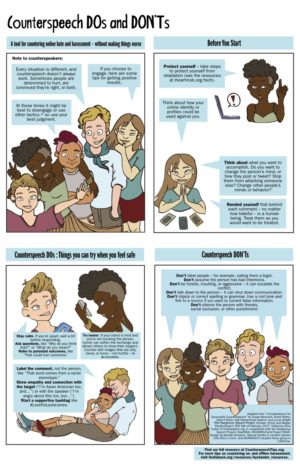
Now, in time for National Bullying Prevention Month 2017, students have solid, research-based guidance for countering online hate, harassment and bullying – in the form of a cartoon!

Counterspeech tips thumbnail
Just a glimpse – click here for the full-size cartoon.

“Counterspeech DOs & DON’Ts” is the result of a months-long collaboration of iCanHelpline.org, iHeartMob.org, #ICANHELP, Project HEAR, The Dangerous Speech Proejct and some outstanding student advisers in California and Connecticut (it was adviser and award-winning essay writer Chet Ellis who advised that a cartoon would be much more accessible to his high school peers).

The resource is based on “Considerations for Successful Counterspeech,” by Susan Benesch, Derek Ruths, Kelly P Dillon, Haji Mohammad Saleem and Lucas Wright – cutting edge research in an emerging field. Included are some points from Megan Phelps-Roper’s TED Talk, which tells the story of how counterspeech can change people and lives and, as of this writing, has been viewed more than 4.5 million times.

I first blogged about Dr. Benesch’s work here after hearing her speak at at both Facebook’s 2015 Compassion Research Day and in a smaller multi-cultural meeting at Twitter. Two things compelled me to ask her about collaborating on (then) a counterspeech curriculum for students: 1) seeing research out of the University of New Hampshire showing that most bystanders try to help peers who are being targeted but hearing from educators that they generally don’t know how and 2) knowing that the bullying prevention field had been focusing more and more on turning bystanders into upstanders (some examples in this Google search). I wanted students to have a really accessible “tool” they could use to be the change-makers they want to be. My partners at #ICANHELP had seen and demonstrated over and over again that students are part of the solution to more than the problem of social cruelty online. So I reached out to our collaborators –HeartMob and their very talented designer Kendall Simpson kindly donated their time for breathing life and color into bullet points – as well as friends at the Born This Way Foundation and Teaching Tolerance to get this tool into the hands of as many students as possible. Please click to the tool for more reference links.

We hope you’ll join us in using and sharing this tool widely. Happy Bullying Prevention Month! Let’s make it real – empower the counterspeakers and changemakers!

Filed Under: iCanHelpline Blog

Game-changing insights on bullying: Research

September 27, 2017 By ICanHelpline

If we want schools to be safe for all kids, we cannot ignore the direct connections between bullying, sexual harassment and homophobic name-calling in middle school. That’s according to groundbreaking research presented by University of Florida psychology professor Dorothy Espelage in her latest talk. One of the U.S.’s leading bullying researchers, she was speaking in Washington at the American Psychological Association, which just honored her with a lifetime achievement award.

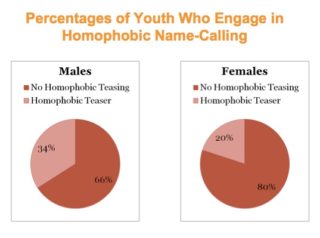
Chart on homophob. name calling“Bullying leads to homophobic name-calling,” which is prevalent in middle school, Dr. Espelage said, “and it also predicts sexual harassment perpetration in middle school” and high school, as well as dating violence in high school and then colleges and universities.
A major new study by Harris Poll for GLSEN found that 55% of students aged 13-18 hear peers saying “that’s so gay” often or very often, 43% other homophobic terms often or very often, and a quarter (25.5%) hear school staff “make negative remarks related to students’ gender expression.”

Factor gender into bullying prevention

Espelage and her colleagues have found that students as young as 5th and 6th graders commonly use that terminology, as many parents know – “especially when boys do not act masculine and girls do not act feminine,” as kids collectively define those terms in their own peer groups and schools. “We found that such homophobic language is used to assert power over other students…. [They] start to sexually harass members of the opposite sex to demonstrate that they are not gay,” she wrote.

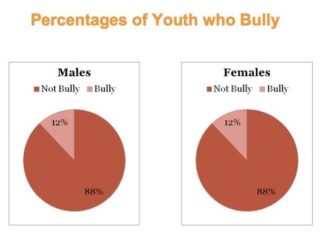
Chart on bulllyingFor that reason, even though most bullying prevention programs don’t factor in gender, they need to, she said in her talk. “We have to recognize that this socialization process, this homophobia and sexual harassment that happens to both boys and girls happens way before we send them to college.

“If we continue to do this [bullying prevention] work in schools with no gender lens, we’re going to continue to fall short,” she said. On the other hand, “if we address homophobic name-calling … we’ll have much improved lives for middle school students, and [this prevention work] will be relevant to them [emphasis mine].” She mentioned one brave 7th grader who told her that he was just so done with the name-calling and didn’t understand why the questions the researchers were asking them didn’t look at the kind of aggressive behavior that irritated and disturbed students like him the most.

Other key highlights from a very comprehensive talk:

  • Social emotional learning is powerful: “Out of the gate, after just 15 lessons” (out of 41 SEL lessons that 3,600 6th-8th-graders received over a three-year study), her research turned up a “major reduction in physical fighting”: 42%, “where most programs predict a 3% reduction,” she said. “By Year 3, Second Step [the SEL program they used in the study] had reduced all forms of victimization – including for kids with a disability.” The findings reinforced what many of us have come to see, including me: that SEL instruction would benefit every student and every school, especially now that social media is part of the school climate mix. Social literacy training for social media (and life!). In her talk, Espelage also pointed to studies showing SEL’s positive impact on students’ academic performance as well as school climate, “and it works at multiple levels of society.” [Here‘s what SEL teaches.]
  • Positive school climates, safe students: SEL, bullying prevention, mindfulness, etc. “We can have all these programs, but we have to understand the larger school climate…. We’ve ignored the adult component – teachers, administrators, superintendents. “You really can’t have the social-emotional competencies in kids if you don’t have them in teachers,” she said, pointing to the need for teachers’ professional development in SEL too. “I [as a student] can have a predisposition to be aggressive, but if I’m in a classroom where the norm is to be pro-social, [that predisposition] will not be turned on,” she said, saying the reverse can be true too, of course. “My individual propensity interacts with classroom norms and ultimately school climate.”
  • If we want students to be “upstanders”: In visits to schools all over the country, Espelage found that, when teachers said they had a social aggression problem in their schools, the students said they didn’t intervene. “We can’t tell kids to intervene if it’s not a safe space,” she said, referring to classrooms as well as school in general. And it has to be a safe space for teachers as well, in this sense: “If teachers feel supported by their school’s administration to do this work in the classroom, the kids are saying aggression is happening less.” They’re bullied less, victimized less, and they fight less. “That’s powerful,” Espelage said, while acknowledging that it’s not easy to make this happen because it’s a multi-level process, but it’s worth it – rewarding for everybody. “You’re not going to be perfect, nothing’s perfect. But go after this – so the kids can perceive you’re doing something, and then they’ll be more caring toward one another.”
  • Taking “the punishment route” doesn’t work. “Principals are very challenged,” Espelage said, because they’re often pressured to use the punitive approach by parents or victims. But progress comes from adults’ supportive responses and modeling of respectful behavior – a huge part of improving school climate. This will have a positive impact on cyberbullying too, she said. “My hope is that, as we create more positive school climates, where kids are bullying and engaging in other forms of aggression less, then when they go into that other [digital] space, that prosocial behavior will be reflected,” she said.
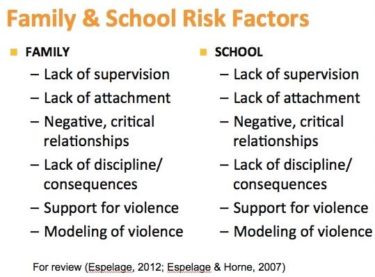
  • Chart about criteria for healthy families, schools
    Chart from Dr. D. Espelage

    A healthy school looks like a healthy family and vice versa (see Espelage’s slide to the right for the characteristics of “healthy” in both cases).

  • Cyberbullying’s context isn’t social media. Seriously. “What I hear all the time from schools is that ‘social media is wreaking havoc’,” Espelage said. But addressing content or behavior in social media doesn’t reduce cyberbullying nearly as much as addressing bullying, homophobic name-calling and gender-based harassment, she said. “Having the attorney general come to school to talk to students” about social media doesn’t really help reduce cyberbullying, she said. That’s because the context of cyberbullying is really young users’ school climate, what’s happening in their peer groups, not media. Bullying predicts cyberbullying more than social media use does. This was a key finding from a lit review produced by a national task force I served on: that a child’s psychosocial makeup and home and school environments are better predictors of online risk than any technology the child uses.
  • If a student comes to you: “Just assume when a kid comes to you and says ‘I’m being bullied, I’m being victimized’ – and of course you’re going to ask them what’s happening, because ‘bullying’ doesn’t really mean much…from Student A to Student B – assume it’s been happening for a while…ask them if they feel they can defend themselves. If they say no, then ask, ‘Who can you turn to, do you feel helpless?’ In some cases, especially LGBT youth, we’re starting to chase after this notion of feeling like a burden to their family. So understanding that some kids feel so depressed and withdrawn when they’re victimized because they don’t want to tell their parents again; their parents thought it stopped…and their mom’s having to take off of work and come down to school…. So the burden piece is showing up to be quite relevant as well…. So we have these components: If it’s been happening for awhile, they feel defenseless, they have no one to turn to, be concerned and do a referral.”

So 1) bullying prevention work needs to reach young people when or before they’re doing their developmental identity formation, which includes gender identity and 2) everybody in the school community has a role in creating a climate of dignity and respect. And 3) when schools decide not to tolerate sexual harassment of any student, they’ll see less homophobic name-calling, more gender equity and less sexual harassment. 4) They’ll also see less cyberbullying, which is bullying happening in what has become just another space where students’ interaction plays out. 5) Punitive doesn’t work: Not only is it clearer than ever that pressure on administrators to suspend and expel not only does nothing to make schools safer, it sends the message that power – which is a component of both punitive responses and bullying – is what solves social problems. It doesn’t. And 6) we now have solid, multi-year research showing that social emotional learning is powerful prevention. It reduces “all forms of victimization,” even for the most vulnerable students, and improves school climate.

Filed Under: iCanHelpline Blog

VR as empathy teaching tool: What to love AND watch out for

May 2, 2017 By ICanHelpline

Just from watching Engadget’s 6 min. video report about it one can tell “The Last Goodbye” – a 16 min. virtual reality experience that debuted at the Tribeca Film Festival that just wrapped in New York – will have a profound impact on anyone who experiences it. The reporter called it “emotionally harrowing.”

Little VR user (CC licensed)

So there are really two central roles in this VR experience: that of Holocaust survivor Pinchas Gutter, who was 11 years old when he was literally shipped to Majdanek, then an extermination camp in Germany-occupied Poland, and that of empathy. Because clearly – based on the thoughtful video report by Engadget reporter Devindra Hardawar – the project is truly all about both. The participant is walking into Gutter’s horrific experience as a child and spending that time with him now, which is beyond extraordinary. Part of it is virtually, immersively, being in – walking around in – the camp with Gutter as he points out what happened in specific locations. “We wanted to ease people into the walk-around,” one of the producers told Hardawar. You can tell that’s needed.

The experience itself is the first part of experiential learning. The other essential part is the reflecting, the thinking out loud, that the participant does about their experience of it. So there’s a third crucial role (if a production is to become a teaching tool) – that of the facilitator or teacher and others external to the experience who are bringing empathy to the overall experience (in and after the virtual part).

Empathy around the VR experience too

So further thought needs to go into empathy’s role. Clearly, based on Engadget’s report, it was central to the project and the producers’ intent. They wanted to be sure the production, the art and the technology, was faithful to the story and the space, they said. In teaching with a tool like this, we’d want nothing less than the level of integrity they’re asserting, right? That’s baseline.

Then there’s the empathy around a teaching tool like this – the kind that supports the participant, especially a child. The producers said they’re not sure what’s next – museums, classrooms, etc. They “want to be able to release it to everyone who has VR headsets.” But maybe it’s not ideally a solitary experience for a child, right? What if it gets into the hands of a child who’s not ready for this “emotionally harrowing” experience? It could be that VR like this needs to be in classrooms and other communities of guided practice, where there are caring adults who know what the children in their care can handle – and who can hold discussions afterwards that give participants context and even emotional support where the experience triggers strong negative emotions.

Related links

  • An award-winning empathy teaching tool available to parents and educators right now is Gifts from the Enemy, the true story of Alter Wiener, a teen survivor of five Nazi concentration camps. Writing for children 8-12, award-winning author Trudy Ludwig tells of how “an unexpected person demonstrated moral courage in repeated acts of kindness” toward Alter. As described in Ludwig’s site, the book aims to show “how acts of social justice and kindness can change lives.”
  • “Four big trends in virtual reality on display at the Tribeca Film Festival” at Forbes.com
  • “How virtual reality can be used to fight prejudice and racism in society” at UploadVR.com

Filed Under: iCanHelpline Blog

’13 Reasons Why’: Talking points for discussion with students

April 28, 2017 By ICanHelpline

Is “13 Reasons Why” a hot topic at your school? Educators we’ve talked with have certainly at least overheard students talking about the series on Netflix. Based on a Young Adult book of the same title, the series has kicked up controversy in the U.S. and other countries and, for a number of reasons, shouldn’t be left just to kids and the news media to discuss.

Netflix logoThe series has its proponents as well as critics. On one hand, it exposes issues today’s high school students often face (among them, depression, bullying, sexual assault and suicide); on the other – if viewed uncritically – it could expose vulnerable young people to way too much. It’s about what happens after a suicide and – as Headspace, Australia’s mental healthcare hotline for schools, told a reporter – it irresponsibly suggests that suicide can somehow right wrongs or cause resolution for the person who has died; and younger or more impressionable people may not yet fully comprehend the finality of death. However, some young people have said the story gives them a better understanding of how much suffering suicide can create for friends and relatives – something they hadn’t thought about.

Fortunately, suicide prevention experts have weighed into the discussion and are offering advice and talking points. Here are advice for young viewers and parents and talking points for educators and clinicians developed by the New York-based Jed Foundation and Suicide Awareness Voices of America (SAVE). As for Netflix, Jed – which is very critical of the series – reports that the entertainment company “was supportive of the distribution of the Talking Points and posted them along with crisis services and a link to additional information about young adult mental health on the official 13RY resource website. Netflix also filmed ‘Beyond the Reasons‘ as a tool to help parents and teens frame the conversation and encourage them to speak up and seek help. The show is rated TV MA and there are trigger warning cards prior to three of the episodes.”

It’s our hope that parents and educators will ask their kids if they’re watching the series and, if they are, whether they’re watching it with friends and, ideally, an adult – not alone. Then don’t hesitate to talk about an episode while it’s fresh in everybody’s minds. Perspective can really help.

Related links

  • In her well-reported commentary in Britain’s The Guardian, columnist Zoe Williams does not hold back: “It’s a revenge fantasy, so it portrays suicide as an act that will achieve something…. It normalises and legitimises the act.”
  • The news coverage has been extensive. Here’s CNN’s “Why teen mental health experts are focused on ’13 Reasons Why’“
  • If “13 Reasons Why” is popular among your students, you could turn the news coverage in these links into a media literacy lesson as well as discussion on the series itself. Here are guidelines for responsible reporting (provided by the suicide prevention community to protect the public). You and your students could analyze various news stories to see if they follow the guidelines – even together write letters to the editor if they don’t. This demonstrates that media literacy is protective of people as well as civic engagement.
  • “New Zealand Teens Now Need Adult Supervision To Watch ‘13 Reasons Why’“
  • “Does 13 Reasons Why’ Glamorize Teen Suicide?” in Rolling Stone
  • “Schools warn parents about ’13 Reasons Why’” at ABC News
  • “Netflix is close to renewing ’13 Reasons Why’ – But Should It?” in TV Guide’s blog

For suicide prevention resources specifically for schools, scroll down to “Bullying and suicide” on this page in our Resources section.

Filed Under: iCanHelpline Blog Tagged With: 13 Reasons Why, Netflix, suicide prevention

  • « Go to Previous Page
  • Go to page 1
  • Go to page 2
  • Go to page 3
  • Go to page 4
  • Go to page 5
  • Go to Next Page »

Footer


Contact

info@socialmediahelpline.com
  • Home
  • About
  • Contact

Copyright © 2026 · All Rights Reserved · The Net Safety Collaborative · Privacy Policy

Top photo by Pavan Trikutam. Lower photo by Marvin Meyer.